Labour trafficking in Manitoba’s trucking industry undermining safety practices, community advocates say
Posted September 9, 2025 5:47 pm.
Last Updated September 9, 2025 8:40 pm.
Labour trafficking in Manitoba’s trucking industry is a major concern, according to community advocates, leaving many drivers unprepared.
The result, they say, is causing safety standards to plummet.
“We have trucks coming into our facility where the drivers do not have the basic skills necessary to operate a large truck,” said Rick Fickes, a trucking logistics coordinator.
“Skills like backing up. Skills like lining up on a dot. Skills like preparing, unloading and loading of their vehicles.”
That, in turn, affects everyone on the road, Fickes says.
“If a truck tips over because its load isn’t properly set, that can take out several cars all at once,” he explained.
He says over past few years, more drivers aren’t grasping basic skills like backing up trucks and properly securing loads and that he’s worried about the safety risks.
“It was just a few years ago that the Humboldt crash was because of an unsafe and untrained driver,” Fickes said.

The trucking expert says he can understand the appeal behind cost-cutting – for both companies and consumers – but ultimately feels safety should be prioritized.
“I can see the attraction for the carrier to make a quick savings on cost, but that comes at the price of unqualified drivers operating unsafely on our roads.”
“Cost-benefit to the consumer is nice. The idea of companies making a profit so they can pay their employees is nice. But ultimately it comes down to safety. If things aren’t safe on the roads, everybody pays.”
Pauline Wiebe Peters, president of the Manitoba Trucking Association, believes the issue with safety directly connects to another problem: trafficking.
“Drivers are coming into our country and they’re being promised wages and they’re being promised jobs,” she said. “And when they get here, they’re having their documentation taken from them and they’re being forced to work for far below industry-standard wages.
“Oftentimes, people are being brought in on LMIAs (Labour Market Impact Assessments) and they’re not receiving the full training and they’re being fast-tracked to just get the bare minimum of training, so they’re just qualifying to get a licence.
“It just breaks all of our hearts, and we want people to be treated fairly and to want to come to Canada, and to make trucking their industry of choice and to be happy here.”

Wiebe Peters agrees the practice is leading to dangerous situations.
“Terrible accidents have occurred because of poor safety and poor driving habits,” she said.
Janet Campbell, president and CEO of the Joy Smith Foundation, says there’s been a rise in trucking-related support calls, but many don’t even realize they’re being exploited.
“This is a criminal offence, and it goes well beyond a bad labour practice,” Campbell said.
“Those that are put in this situation are victims. They’re being put in a position that they don’t have a choice of what they need to do and they’re absolutely doing the best that they can.
“Everybody deserves to have dignity and freedom and to be paid in accordance with what the commitment was in their position.”
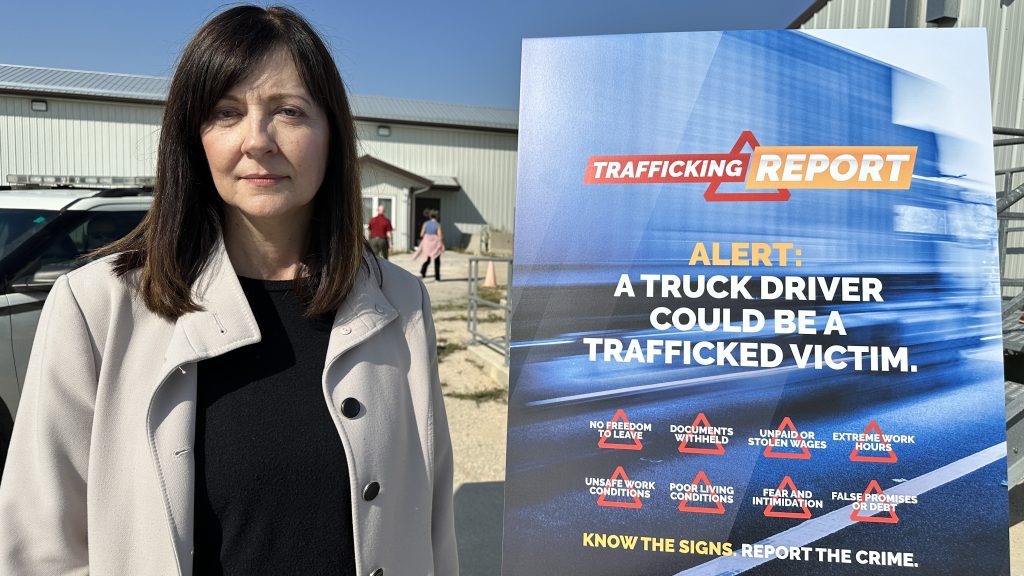
That’s why advocates are urging people to reach out for support, whether that’s to the foundation, the trucking association, or even Crime Stoppers.
“If there’s one individual that somehow we can provide help and support to in this process, that would truly be a victory. These are people’s lives,” Campbell said.
“I think if somebody is questioning that something could be going on, it’s a good idea to reach out.”
The Joy Smith Foundation launched a campaign Tuesday to raise awareness of labour trafficking in the Canadian trucking industry, with the call to action “Know the signs. Report the Crime.” It will be distributed through billboards, posters and digital resources, including a new website with education materials.