Majority of kids injuring in off-road vehicle accidents not wearing helmets: Manitoba doctor
Posted June 25, 2025 5:28 pm.
Last Updated June 25, 2025 8:49 pm.
For Manitobans, young and old, jumping on an off-road vehicle and hitting the trails is one of the best ways to spend the summer months; however, according to a new report, for far too many riders, their adventure is ending in the emergency room.
Less than 24 hours after a collision between a semi-truck and an off-road vehicle sent a pair of young adults to the hospital, CityNews learned that these kinds of accidents are becoming far more frequent.
According to a study by Manitoba Public Insurance, since 2011, over 600 children have visited the Children’s Hospital ER at Winnipeg’s Health Science Centre.
“Off-road vehicles they’re part of life in Manitoba, but we all share the responsibility of making sure youth riders are protected so they can enjoy those experiences safely,” said Matt Wiebe, Minister of Justice.
Many of these accidents take place off public roads in rural communities, researchers believe the data under-represents the true scale of the issue.
Dr. Lynne Warda, a leading pediatric emergency physician at HSC’s Children’s Hospital, says over the past four years, they have seen nearly a hundred pediatric injuries sustained on an ORV annually. A lack of parental supervision and helmet use plays a significant role.

“In terms of helmet use, it’s pretty infrequent, 34 per cent in our database,” Dr. Warda explained.
Of those annual cases, Dr. Warda says 32 per cent of injuries result in hospitalizations. The severity varies from a traumatic experience to something far more serious.
“The sickest kids go to the operating room emergently for neurosurgery, have blood clots evacuated from their brains. It’s a really huge deal, they then recover in the intensive care unit, and you never really know what the ultimate outcome will be until time passes,” said Dr. Warda.
Terris Baran, of Safety Services Manitoba, says that parental supervision is required under Manitoba law for riders between the ages of 14 and 16. He believes a required training program would go a long way in ensuring riders are properly prepared prior to hitting the trails.

“I tell the children always you’re not invincible, you’re just lucky until you’re not,” said Baran.
“They are very quick, there are regulations within them, in terms of size limitations, passengers, and things like that, so to give people a good background basis of a learned skill that would be ideal.”
Manitoba Public Insurance (MPI) says the following safety tips should be followed by all ORV users:
- Manufacturers include age guidelines based on the size and power of each ORV. These guidelines should always be followed to help prevent injury. A child should never operate a full-size ORV meant for adults.
- Young riders should always have hands-on adult supervision. Parents and caregivers play a big role by modelling safe riding and making sure children are
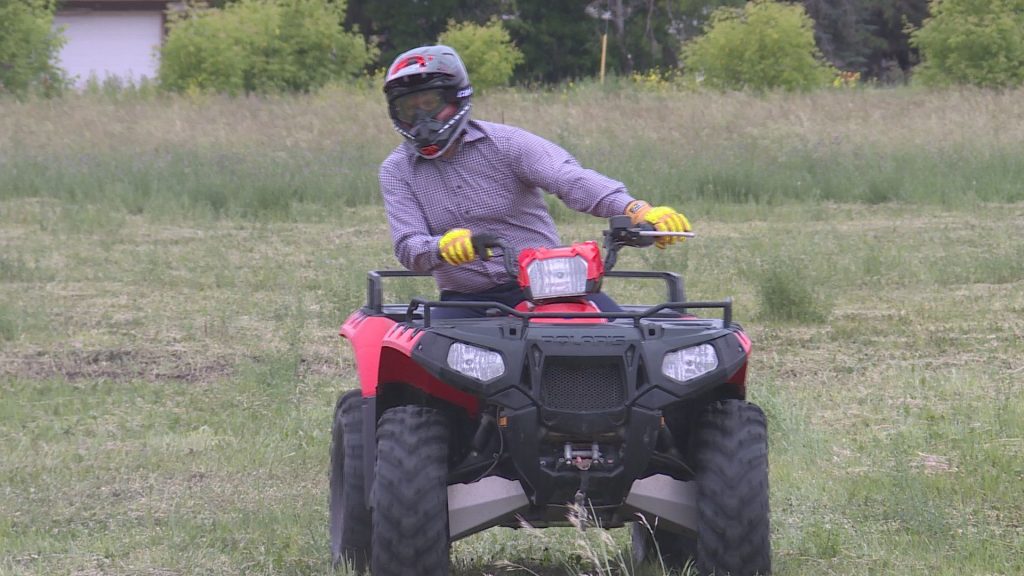
trained. Enrolling children in certified safety training courses, such as those offered by SSM, is a great way to teach them about handling, speed control, and terrain awareness. - A DOT-approved helmet is required for all riders and passengers. Other recommended gear includes eye protection, gloves, long sleeves and pants, over-the-ankle boots, and chest and shoulder protection.
- Farm work should always match the rider’s age and the machine’s capabilities.
Youth-sized ORVs are not built for towing or hauling. - Don’t carry passengers on single-rider ORVs.
- Avoid paved roads unless absolutely necessary and legal.
- Ride in daylight, on familiar terrain, and at safe speeds.
- Always slow down on hills, corners, and rough patches. Most rollovers happen when going too fast on these types of terrain.
- Be cautious with unpredictable terrain like mud, loose gravel, or steep slopes, as they can quickly lead to loss of control.
- Stick to designated trails or areas where permission has been granted.
- Avoid environmentally sensitive spots like wetlands or wildlife zones.