B.C. Conservatives win majority government, Lorne Doerkson set to become next premier
Posted October 24, 2026 11:00 pm.
The resurrection of the Conservative Party in British Columbia is complete.
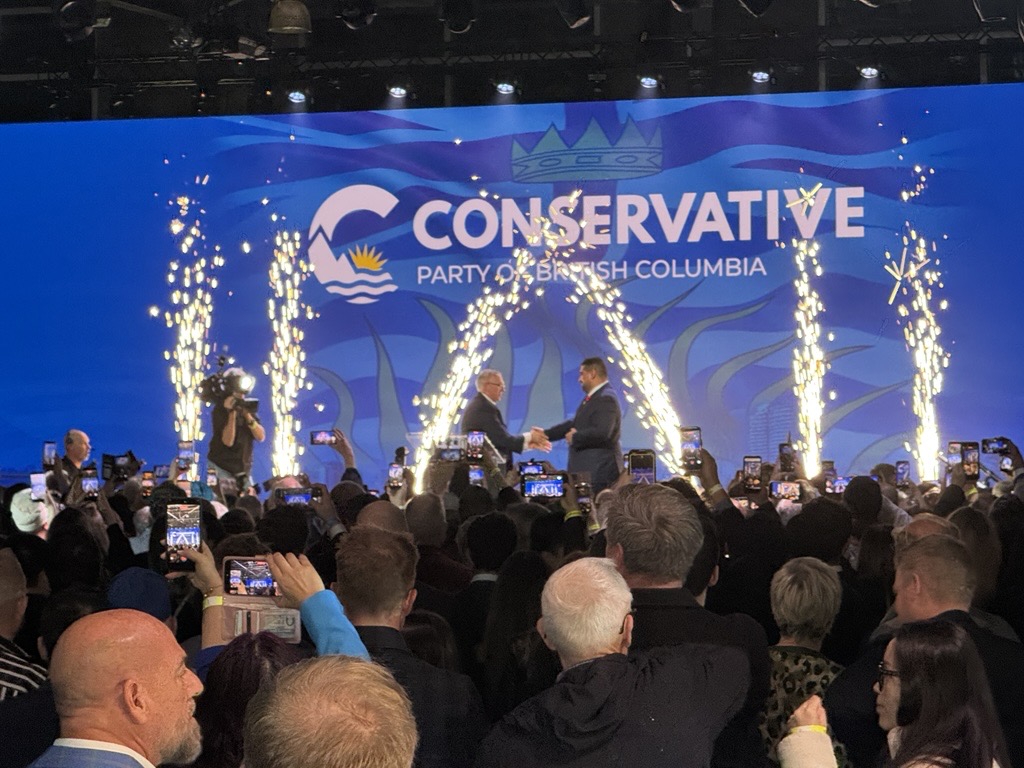
B.C. Conservative interim Leader Lorne Doerkson led the party to a resounding victory over incumbent David Eby and the BC NDP in Saturday’s provincial election.
The Tories are projected to form a majority government, with Doerkson set to become the province’s next premier.
“Tonight British Columbia made a choice, and it is going to be the honour of my lifetime to serve you as your premier,” Doerkson told his supporters in Vancouver as they chanted his name. “I am gonna give this job everything that I’ve got. I promise you that. And I also promise you that I won’t get it all perfect, but when I don’t, I’m gonna tell you, and then I’ll get back to work. We’ve got a province to build, and I can’t think of better people to build it with than you. This is strong leadership for serious times.
“Let’s do this, British Columbia. We are gonna get to work unlocking the endless possibilities of our province and our people, and in every corner of it, I am ready to deliver for all British Columbians.”
Doerkson’s transition from a little-known MLA from Cariboo-Chilcotin to board-appointed party leader to premier-elect in less than five weeks is one of the fastest successful ascents to power – by way of a general election – in Canadian history.
It also completes a stunning reversal for the Conservative Party of British Columbia, which went from a virtually dormant fringe entity in B.C. politics – failing to elect a single MLA for nearly half a century – to a governing party in a few short years.
And they did it by winning in key battleground ridings in Surrey, the North Coast and others across the province. The victory was confirmed roughly an hour after polls closed, accentuating the remarkable nature of the Conservative win.
“Together, our best days are still ahead of us, my friends. I promise you that,” Doerkson said in his victory speech. “So when I say that we are going to supercharge British Columbia, I want you to know where it happens. It isn’t going to happen on one street or in one city.
“It happens in Kitimat, where B.C. natural gas leaves to power the world. It happens in Fort St. John, where the gas comes out of the ground. In Prince George, Quesnel, and Williams Lake, where a mill job should still pay a family nicely. In Kelowna and the Okanagan, where orchards run right up against the tech companies. Up and down Vancouver Island, where the fishing boats still go out before the sun comes up. And in the Kootenays, where they’ve been smelting metal in trail for more than a century. In Surrey, on its way to becoming the biggest city in our province. And yes, in Vancouver, where the ideas and the head offices are.
“Every one of those places is part of the same engine. A mill running in Quesnel keeps a trucker working in Surrey. A mine opening in the north keeps a port busy in Delta. It’s one economy, and it runs through every town on our map in British Columbia. That is what a B.C. that works for everyone means. We will be the catalyst. I promise you that.”
The result seemed implausible just 32 days ago, when Eby gambled by calling a snap election a full two years before the next scheduled vote, despite having a one-seat majority in the legislature.
Eby initially told British Columbians he needed a stronger mandate to deal with the economic uncertainty brought on by Donald Trump and U.S. tariffs. He later said the election was needed to end the frustrations of a “stalled out” legislature. His opponents viewed it as an opportunistic strategy given widespread chaos within the Conservative ranks at the time.
Either way, the decision backfired for Eby and the BC NDP, which failed to slow the Conservatives’ momentum once Doerkson was installed as party leader – a move that immediately reversed the near-daily defections under the previous reign and reunited a large swathe of the right-of-centre vote in the province.
Now the New Democrats have been reduced to the role of Official Opposition for the first time since 2017 as voters opted to move away from left-leaning politics on a night where Eby, who was elected in Vancouver-Point Grey, announced he would be stepping down as party leader.
“This is obviously something I do with a very heavy heart,” Eby said in his concession speech. “But it is time for new leadership within our party.”
Emily Lowan and the BC Green Party were projected to come in third. Lowan, in her first election, won her seat in Saanich North and the Islands. She said there was a “heaviness” in her heart over the Conservative win.
Doerkson shared words for both Eby and Lowan in his victory speech.
“I want to recognize David Eby tonight,” B.C.’s premier-elect said of his predecessor. “Public life asks a lot of us all. It asks a lot of a person and a lot of their family, and he has given to this province for years of both of those things. So thank you very much, David Eby.
“I also want to recognize Emily Lowan and congratulate her on an incredible campaign. British Columbians can be grateful for her passion, all that she’s done to inspire thousands of young British Columbians to get involved. So thank you, Emily.”
OneBC interim leader Dallas Brodie and CentreBC Leader Elenore Sturko lost their bids to stay in the legislature.
Brodie lost in Vancouver-Quilchena to B.C. Conservative candidate Carson Binda, the former provincial director of the Canadian Taxpayers Federation. Sturko lost in Surrey South to Conservative Megan Knight. It’s a seat Sturko had held from 2022 to 2024, first as a BC Liberal before she crossed the floor to the Conservatives.
‘Most prosperous province in this country’
The Conservative costed platform, which was only released a few days after advance voting had already begun, presented a plan to “supercharge” B.C.’s economy by bringing in new revenue without cutting front-line services or raising taxes. The party described the platform as one of restraint, not austerity. It vows to shrink the deficit to $10.8 billion by 2030.
The Tories ran on promises to cut income tax; approve new home builds with less red tape; replace the no-fault insurance model with a hybrid system; open more child care spaces and create 24-hour child care for certain professions; repeal the Declaration on the Rights of Indigenous Peoples Act (DRIPA); and expand natural gas and LNG development.
“Here’s what I want: a British Columbia that is the most prosperous province in this country, the place where investment goes first, and the place the best people choose to build their lives,” said Doerkson in his speech. “I want a B.C. where a hard day’s work gets you a family home and a future right here in this beautiful province.
“I want to say a word to the people who aren’t in this room: there is a place for you here. Bring your ideas. Bring your family. Bring your ambitions. And somebody will pick up the phone in British Columbia.”
In a post on X, Prime Minister Mark Carney congratulated Doerkson on his victory.
“I look forward to working with you as Premier to get more homes built, unleash our full potential as an energy superpower, and build a stronger British Columbia and a stronger Canada for all,” he wrote.
From the ashes
For the longest time, the B.C. Conservative Party operated as a minor entity in in the province, with right-of-centre votes largely being cast for Social Credit and later the B.C. Liberals. Just six years ago, the Conservatives received less than two per cent of the vote in the 2020 provincial election.
Enter John Rustad, a former B.C. Liberal who joined the Tories in February 2023 and became party leader the following month. Under Rustad’s leadership, the Conservatives won 44 seats in October 2024 – just three shy of forming government.
Amid infighting, departures and expulsions of caucus members, Rustad was forced to resign as leader last December, triggering yet another period of turmoil for the party. After several months under interim leader Trevor Halford, the volatility returned when Kerry-Lynne Findlay took over, tilting the party further towards the right.
Findlay’s 113 days in charge saw multiple MLAs exit the caucus – they either quit or were fired – as debate raged over the proper direction of the party. The Conservative caucus fell to the mid-20s in the final moments of her leadership. She quit Sept. 20 – two days before Eby called the snap election.
The remaining members of the embattled Conservative caucus recommended Doerkson take over as party leader. Doerkson hurried back from a trip to Africa and immediately brought several legislators back to the Conservative fold.
Two days later, he was campaigning to become premier at the helm of a party he only joined in 2024.
“This was obviously a campaign that was predicated on Kerry-Lynne Findlay being the leader of the Conservative Party,” political analyst Hamish Telford told CityNews shortly after Doerkson’s election win. “When she resigned, really he (Eby) shouldn’t have gone through with the election. He should have called it off on the grounds that the opposition didn’t have a leader. But he put the trains in motion and he couldn’t stop them. And he never really had a message track after that. He didn’t have a plan B. He should have anticipated that he didn’t, and he’s paid the price tonight.”

Doerkson was one of the first defectors to the Conservatives from BC United as that party imploded in the wake of its name change from the B.C. Liberals.
Before his elevation, Doerkson’s time in the legislature was spent mostly hyper-focused on his riding and region, beset by wildfires and hospital emergency room closures.
Doerkson’s time as publisher of the local newspaper had put him squarely at the heart of the community. He’s also a former rodeo rider, who has framed positions on health care from his perspective as a former visitor to emergency rooms.
Doerkson referenced those days in his victory speech — and what they taught him.
“I have watched a lot of people get thrown at a rodeo, and I’ll say I’ve been thrown a few times myself,” he said. “But what I’ve learned from that is that you pick yourself up, dust yourself off, and you get back on. And the crowd gets to its feet for you because you’re trying. That is the approach that I have brought to my political life.
“And as communities throughout my riding have fought fires and floods, I have stayed with my neighbours and pitched in where I could. That taught me what strong leadership for serious times really means. It isn’t loud. It’s showing up. It’s telling people the truth. It’s keeping the promises that you have made, and it’s owning it when you get something wrong, and getting back to work.”
Dodging controversy, criticism
On the path to victory, the Conservatives managed to sidestep some controversies, particularly concerning their candidates’ social media posts.
Jordan McIntosh, an 18-year-old candidate for Vancouver-Strathcona, was dumped over online posts that included saying Adolph Hitler killed “lots of Jews” not because he “hated them specifically” but because there were so many of them. Another candidate, Joachim Agou, was ejected from the party for online comments saying the driver of a car that rammed a pro-Palestinian protest group in Switzerland should have “reversed too.”
Also coming under fire was Katy Merrifield, the election campaign director for the B.C. Conservatives, for an anti-Islam social media post in which she said the religion was an “abhorrent ideology” that needs to be expelled. Doerkson defended Merrifield, saying the post was made in a moment of trauma. The decision to keep her on was criticized by the New Democrats.
Doerkson’s opponents also condemned the party for not dropping Chilliwack North candidate Heather Maahs for comments she made about the SOGI 123 program. During a podcast appearance in 2022, Maahs said the program was “not just sex education that has gone too far” but may even be a form of grooming.
The Conservatives were also criticized for a noticeable lack of media availabilities in the final stretch of the campaign, and for not allowing reporters to ask Doerkson follow-up questions at news conferences. Also raising eyebrows was a decision by the Conservatives that Doerkson would not be doing interviews on election night if he won.
–With files from The Canadian Press